What should Dems do? Read Asymmetric Politics

train wreck

I urge anyone who has strong opinions about what the Dems should do to read Asymmetric Politics.

I hate to put my thesis first, but here I will. I’m seeing a lot of centrists arguing that the DNC should support centrist candidates, and self-identified leftists saying it should be leftists. And there are people who are saying that the DNC should have a coherent message, or various other narratives that assume the DNC is at the wheel. The DNC cannot guarantee that opponents of authoritarianism can win the midterms by only putting forward candidates with one ideology and one policy agenda. What will work is cracking holes in the dyke of support for Trump, and that means NOT sharing posts from irresponsible anti-Trump sites. Sharing information that it’s easy for Trump supporters to dismiss as false or misleading confirms their support for him, and their sense of a binary of unbiased and objective people (Trump supporters) and biased liars (his critics and opponents).

Here’s the longer version. Whenever there is a really complicated and nasty political situation, there is a tendency for some people to assert that it’s actually really straightforward, and there is a simple solution. That response is emotionally satisfying, since it’s what people really, really want to hear when things are getting twitchy, but, as a scholar of train wrecks, I can say it’s never true.[1]

There is always a tendency for people to think about policy questions from our own perspective. We unintentionally assume that what we want is what everyone wants (or should want). I always think of this as the Rousseau problem. Rousseau assumed some univocal identity of “the people” who had all the same needs and interests.

Drifting around the digitally-connected world, I’ve learned that there’s an interesting variation on the notion that all real people really have the same needs and interests, and it’s one that troubles anti-authoritarians particularly: the tendency to assume that everyone reasons as we do. There is a tendency among people who oppose Trump to assume that the Dems could win if they just used different rhetoric and/or had a different policy agenda. And it’s always the rhetoric or policy agenda that person endorses. So, it’s an argument that, were the people making decisions in the DNC to behave more like the GOP (one policy agenda, one rhetoric) and find the right policy agenda and rhetoric, then the Dems could win. That isn’t how Dems and potential Dems approach politics.

GOP voters will vote for a dead person rather than a Dem. People likely to vote Dem don’t have that kind of party loyalty. (Which, I think, is good on the whole, but it’s a problem when we’re no longer in a pluralist system.) Dem and potential voters are about policies. So, all that the GOP has to do to win is to persuade potential Dem voters not to vote Dem. That’s how the math works. So, what does that mean about what voters who will not vote GOP, but are unhappy about Dem policies and candidates, should do? And I should say that I really hate the DNC. For all the reasons.

But here’s where I’ve landed.

The current GOP, which is not conservative, has a base that is about ideology and ingroup loyalty (as the conservative Haidt long ago showed). It is reactionary (a topic on which Mark Lilla has written beautifully). And the ideology is strategically vague, but functionally mostly negative (as Paul Johnson has shown): supporting the GOP means [slogans not reasonably attached to GOP policies] and actions that are simply about feeling victimized by the hobgoblin of “libruls.” That approach to politics works because self-identified “conservatives” commitment to loyalty means that they are loyal to their sources of information.

People likely to vote Dem are not motivated by ideology. They (we) care about policies. It’s a coalition. I have to say Asymmetric Politics surprised me—I thought the GOP was a coalition, in that it has people who actually wildly disagree with each other on all sorts of policies, yet they work together. That seemed like a coalition. But a coalition is a group of people with disparate interests who agree to work together.

What I’ve come to believe from drifting into pro-GOP sites and conversations is that supporters of the GOP don’t know they disagree—they just agree on hating on the hobgoblin. Fox is not as extreme as some pro-GOP media sites, and that’s the only one I intermittently check, and they never mention anything that might undermine support for Trump—ranging from his falling asleep, rambling incoherently, openly lying, how many of his policies are oriented toward his family’s pockets, or the irresponsibility and internal incoherence of his policies.

Here’s my point: What matters most about people who currently support the GOP is that their sense of loyalty means that they have no clue what the GOP is actually currently doing.

Showing that progressives won in very pro-Dem areas is not evidence that that particular agenda and rhetoric will work in other areas (although I really, really wish it did.) That advice falsely assumes that Dems are like the GOP—that there is one ideology and one set of policies will work for all potential Dems. There isn’t. There shouldn’t be. That would make the Dems just a mirror image of the GOP; that is, anti-democratic and anti-pluralist.


[1] The book I’ve never written is about toxic self-help rhetoric, and how toxic self-help rhetoric promises “this one weird trick” or “you just have to”. (The adjective is restrictive.) Not all self-help rhetoric is toxic. I’ve got a site that has a lot of advice about scholarly writing—in other words, self-help rhetoric. And it cites a lot of advice and sources that are self-help rhetoric.)

BSAB: “Both sides” and the slavery debate

cover of book on the slavery debate
https://www.uapress.ua.edu/9780817381257/fanatical-schemes/

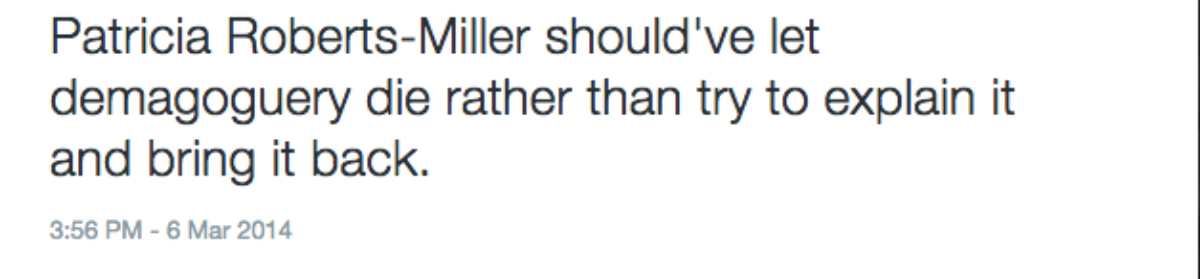
As I’ve said many times, as soon as a public, media, or person frames our complicated world of policy options as either a binary or continuum of two sides, then it’s all about in- and out-groups, and our shared world of policy disagreements isn’t the kind of disagreement that can help communities come to pragmatic solutions. It’s some degree of demagoguery. Maybe it’s a horse race, maybe it’s a full-throated call for political or physical extermination. But it’s never useful for effective deliberation, about anything. Because there are never just two sides about any policy. And while one can describe our political situation as a binary or continuum, one can also rate all political figures on the basis of whether they agree with your narrow policy agenda. One can also arrange all candidates on the basis of how much they use the letter ‘E’ in their messaging. One can find a lot of ways of categorizing political figures and group commitments—that doesn’t mean those categories are useful ways to think about what policies are best for our shared world.

What framing our complicated world of policy options as a binary or continuum does is to fame is it as us v. them. And so we engage in motivism, the genus-species fallacy, and various forms of ad hominem.

Once political disagreements are framed as conflicts among various identities (either a binary or continuum), then we don’t deliberate together, and that is what is supposed to happen in a democracy. Democracy thrives for everyone when people try to work together to solve problems. They can argue, vehemently, petulantly, emotionally, but with each other.

And, really, this is something we all know to be true. The moment that a conflict in your church, family, workplace, garden club, D&D game, neighborhood mailing list, or whatever is framed as a conflict of two sides is the moment that people stop deliberating and start taking sides. They might still debate, but they aren’t deliberating. And the train is wobbling on the tracks.

Here’s an example of a time that binary/continuum was (and is) both false and poisonous: antebellum debates about slavery, and postbellum narratives about what happened. [If you want me to cite sources for everything I’m saying, go here. ]

There weren’t two sides to the debate about slavery, yet that’s how the issue is described, in everything from textbooks to popular understandings.

There were at least eleven.

1) Slavery should be expanded to all states, so that there should be no such thing as a non-slave state. In other words, they didn’t believe in states’ rights.

2) If you enslaved someone in a pro-slavery state, you should be able to take them into any state, and ignore whatever laws that state had about slavery. Again, a stance that made clear that it wasn’t about states’ rights.

[So, let’s stop pretending that slavers were pro- states’ rights. They didn’t recognize the right of a state to ban slavery. If you think I’m wrong, cite sources that show that pro-slavery rhetors thought states had the right to ban slavery. Good luck with that. Also Dred Scott. Also you’re saying that the people who called for secession were liars, since they said it was about slavery.]

3) Slavery should be allowed in current slaver states, and every additional state should be balanced in terms of slaver or not, so that anti-slavery states couldn’t have more than 50% of the Senate. (The 3/5th clause pretty much guaranteed them the House.) The electoral college also did (again, 3/5th clause), so this was not a compromise, but a pro-slavery policy, and a violation of states’ rights.

4) We should restrict slavery to current slaver states, and not let it expand.

5) Slavery will die out for economic reasons, and so there’s no reason to try to resist slavers’ actions.

6) Slavery will die out, and result in large numbers of ex-slaves, so we should “re-colonize” freed slaves (this persisted until the 20th century, since it’s essentially Theodore Bilbo’s argument).

7) We should institute a slow ban on slavery, giving slavers the opportunity to sell their enslaved people to areas where slavery was still legal. (This was done in many states).

8) We should ban slavery, and recompense slavers.

9) We should institute a slow ban slavery, recompense slavers, and return all freed slaves to Africa (not a party they were from; sometimes this proposal included second or third generation Americans).

10) We should ban slavery and not recompense slavers.

11) We should ban slavery, and fully integrate African Americans as we have other ethnicities.

Notice that five and six are not anti-slavery, but also not pro-slavery. I have trouble characterizing three or four as anti-slavery, since they were allowing slavery to continue. Pro-slavery rhetors treated those polices as anti-slavery because slavery as an economy was about buying and selling the enslaved people, so, i slavery didn’t expand, then there wouldn’t be a market, and then slavery wouldn’t be profitable. (If you want the chapter and verse on that argument, it’s here.)

Even the positions that could be characterized as anti-slavery (8-11) or pro-slavery (1-3) were substantially different from one another in important ways.

This isn’t a case where, sure, there were subtle distinctions within each of the “two sides,” but there were basically two positions. There weren’t. And, oddly enough, had the pro-slavery rhetors been willing to think and argue pragmatically about the long-term ethical and economic consequences of slavery, they wouldn’t have started an unnecessary war. (Had slaver states taken the most expensive option—free and colonize the enslaved people and be recompensed—it would have cost them less than the war they started.)

And, if at this point, you decide I’m wrong and won’t check my sources because you’ve decided I’m out-group, then you’re making the same mistake that pro-slavery rhetors did.

Because pro-slavery rhetors decided that the complicated world of possible policy options about slavery was actually a binary, they murdered people who criticized slavery, instituted a gag rule in Congress, criminalized criticism of slavery, and started a war they lost.

Pro-slavery rhetors should have taken seriously the criticisms of their position. They should have been open to pragmatic discussions about policies, instead of turning a complicated situation into a binary of identities.

What does all this have to do with the BSAB (Both Sides Are Bad) position? I’ll get to that in the next post.