
For fun, I like to read Golden Age mysteries, and so recently picked up The Wrong Murder Mystery (Charles Barry) which was published in 1933. The book begins with a public controversy caused by a judge advocating legalized euthanasia for the incurably ill “surrounded with a number of safeguards” such as “consent of the person concerned, given before a magistrate” and he goes on to say:
I can even imagine cases where I should legalise euthanasis for persons not actually suffering from disease. I am aware that the religious bodies on this country will probably not agree with this opinion and that they will in all probability take exception to it, but—ahem!—we are not governed in this country by the ecclesiastical authorities—yet. (12)
The first sentence of this last quote shows the judge to be the kind of person who would escalate from what amounts to assisted suicide to Nazi-style eugenics.
A character who is appalled by the judge’s comments explain to another why the judge believes what he does:
A good many very honourable and estimable people have been brought up not on Christian principles at all but on pagan, materialistic lines, and to them the idea of human suffering from illness or any other cause is more abhorrent than the idea of ending that suffering by legalized painless death. Mind you, even we—you and I—would put a bullet in the head of a horse with a broken back, and when you have been brought up to look on man as merely an animal whose brain has been developed a bit more than that of the horse, you can’t be said to be a moral or mental pervert if you show signs of wanting to apply the same medicine to human beings. (37-38)
In other words, the judge’s stance on euthanasia and eugenics is framed as the necessary consequence of his believing in Darwinism. It’s also worth noting that various characters in the book assume that there is a necessary connection between beliefs and group identity. For instance, “ecclesiastical authorities” are the ones preventing euthanasia. And, when one character abandons his support for euthanasia, it’s causally associated with his converting to Catholicism and coming to believe in an immortal soul.
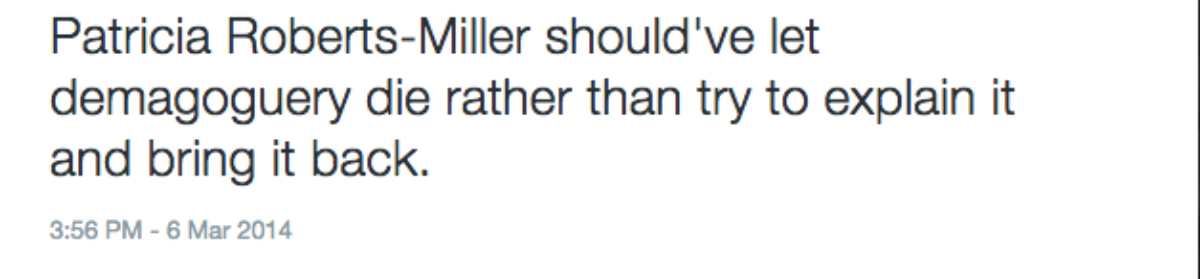
I’ve written a fair amount about demagoguery as a strategy to prevent or shut down deliberation on an issue, and pointed out that it isn’t necessarily deliberate. People engaged in demagoguery often do so because they sincerely believe there is no need for deliberation—the correct course of action is obvious to good people. One of the factors that can contribute to lack of faith in the benefit of deliberation is the assumption that beliefs have necessary consequences, an assumption that invites us to believe that conflicts are between people who good premises and people who have bad ones—that is, all policy conflicts are really group identity conflicts. And, of course, why would one deliberate with people who have been raised to have bad premises?
My point is: beliefs have consequences, but they aren’t necessary consequences.
To explain that point, I have to explain a bit about euthanasia and eugenics. (If you’re already familiar with the history of eugenics and euthanasia in the US, you can skip this next paragraph—it’s just making the oft-made observation that being religious didn’t necessarily guarantee opposition to eugenics, and believing in Darwinian evolution didn’t necessarily guarantee support.)
By 1933, eugenics was mainstream in science education. It ranged from what we would consider genetics to ways of thinking about genetics that implied eliminationist policies. The latter form assumed that antisocial behaviors were the consequence of genetics, and was often associated with a sense that the cream of the genetic crop had been eradicated by the bloodbath of WWI (in Europe) or was being diluted and displaced by lower races/ethnicities (in the US). Therefore, the argument ran, people should be encouraged to marry people with good genes and discouraged from marrying people genetically destined to have inferior offspring (the so-called “positive eugenics”). “Negative eugenics” involved forced sterilization. Both negative and positive eugenics advocated the criminalization of “mixed race” marriages.
While the official stance of the Catholic church was in opposition to sterilization (or birth control more generally) and euthanasia, there was no formal objection to Nazi Germany’s policies of sterilization and extermination of various groups, and minimal protest to euthanasia. In the United States, forced sterilization and segregation were defended on both “scientific” and “religious” grounds. One of the most famous advocates of eugenics, Francis Galton, continued to practice religion, and some eugenicists insisted that their policies were compatible with Christianity (citing passages such as the one about thorns not being allowed to grow in desirable crops). And not all people who believed in evolution were supporters of eugenics, such as Franz Boas. Germany was a very religious country when the Nazis came into power. Being religious didn’t necessarily prevent one from supporting Nazis, or becoming someone who would engage in mass murder (see, for instance, Ordinary Men or Theologians under Hitler).
Were I Queen of the Universe, something emphasized in K-12 schooling would be understanding the distinction between “B was caused by A” and “A necessarily causes B” (or “B necessarily follows from A”). The first is a narrative about a specific or perhaps even common set of events, and the second is the declaration of a determined cause-effect relationship. The glass I was holding fell to the ground because of gravity, but that doesn’t mean that gravity will cause every glass I hold to fall to the ground—there are other factors. It gets even more tenuous when we introduce identity. I am a resident of Texas, and I often spill my coffee, but my being Texan doesn’t cause me to spill coffee, and my spilling coffee doesn’t cause me to live in Texas.
So, why do people so often assume necessary connections between beliefs and between beliefs and group identity?
I’d suggest that we like believing that our membership in a group is necessarily connected to good beliefs and good policies. Believing that the connection is necessary gives us a sense of security about ourselves, and about whether we might be capable of engaging in unethical actions or supporting unethical policies. If we believe that actions and policies necessarily follow from beliefs, and necessarily imply group identity, then we have the option of telling ourselves that, of course, we would never advocate bad policies because we are good. Our beliefs necessarily imply other and only good beliefs and good policies. That sense of certainty about the necessary relationship of group identity, beliefs, and policies means we don’t feel that we need to do the hard work of deliberating—of listening to arguments that we might be wrong, or they might be right, or that the world is more complicated than we think.
Does believing that our group is good necessarily mean that we will support unethical practices or beliefs? Not necessarily. We still have to deliberate.